Patios and Fire Pits Facing the Water
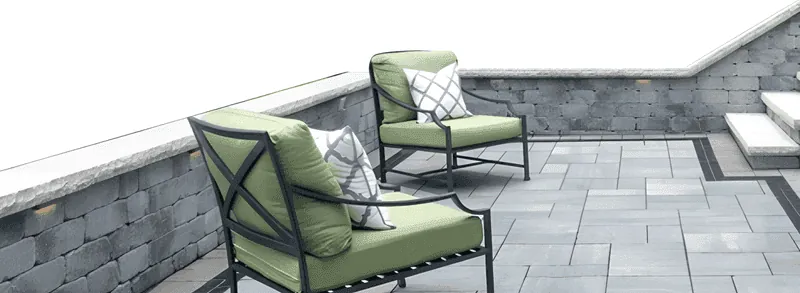
A lake lot usually wants two outdoor rooms: one up by the house for eating and grilling, and one lower down toward the water for sitting around a fire in the evening. Connecting them with steps or a path that works at night is as important as either patio. Pavers or natural stone on a compacted base hold up to Michigan winters, and a wood-burning or gas fire pit at the lower level is where most of the evenings end up.
Near the water the soil can change from one end of the lot to the other, and the ground close to the shore stays wetter. The base under a lakeside patio gets built for the wettest part of the site, not the driest.
Retaining Walls on the Slope to the Lake
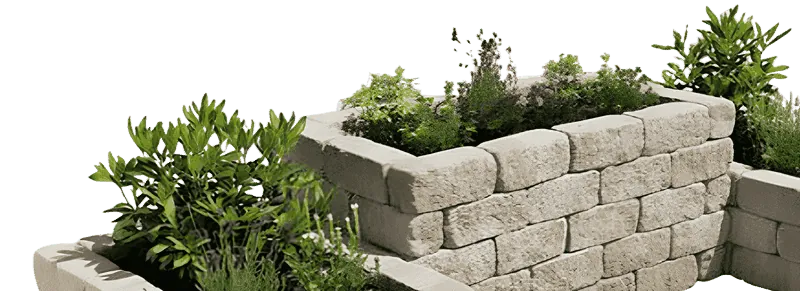
Most lakefront lots drop toward the water, and a retaining wall is how that slope becomes a level lawn, a patio pad or a terraced planting bed. A wall on a lake lot has more water to deal with than most. It needs drainage stone and a drain pipe behind it, a solid compacted base, and a plan for where that water goes, so it does not wash soil and fertilizer straight into the lake.
Where a slope does not need a wall, deep rooted plantings hold soil better than lawn mowed to the edge, and they filter runoff before it reaches the water.
Where the State Permit Line Falls
Work at the water’s edge is regulated by the state, not only the township. Under Part 301 of Michigan’s environmental code, the Department of Environment, Great Lakes, and Energy (EGLE) requires a permit for construction on inland lakes and streams, including new or replacement seawalls and riprap or boulder placed below the ordinary high water mark. That line is not always where the water happens to be on the day you look.
The practical upshot is to keep upland projects, such as patios, walls and plantings, clearly above the shoreline, and to treat any seawall or shoreline armoring as its own permitted project with its own timeline. Mixing the two is how a simple patio job ends up waiting on a state review.
Yard Waste in Commerce Township
Since July 2024, yard waste collection has been part of the township-wide residential refuse service, collected by Priority Waste on your regular service day. The season runs from the first full week of April to the first full week of December. Use biodegradable kraft paper yard waste bags or 32 to 35 gallon containers marked Yard Waste, 50 pounds maximum each.
Brush and limbs over 2 inches in diameter are collected with the trash if they are bundled and tied with heavy twine or rope, no more than 4 feet long, 18 inches in diameter and 50 pounds. Christmas trees are collected at the curb for three weeks after Christmas Day.