
If you are planning a patio in Michigan, the choice usually comes down to two materials: interlocking concrete pavers or stamped concrete. Both can look great the day they are finished. The difference shows up around year five, after a few winters of freeze and thaw, road salt and clay soil that moves.
This guide compares them on what actually decides how a patio ages here. For layout and design help, see patio design. For poured work, see concrete, and for everything built from stone and block, see hardscaping.
How Each One Is Built
Stamped concrete is a single poured slab. Concrete goes down over a compacted base, is colored and stamped with a pattern while it is still wet, then cures and is sealed. Control joints are cut in to guide where the slab cracks as it shrinks and moves.
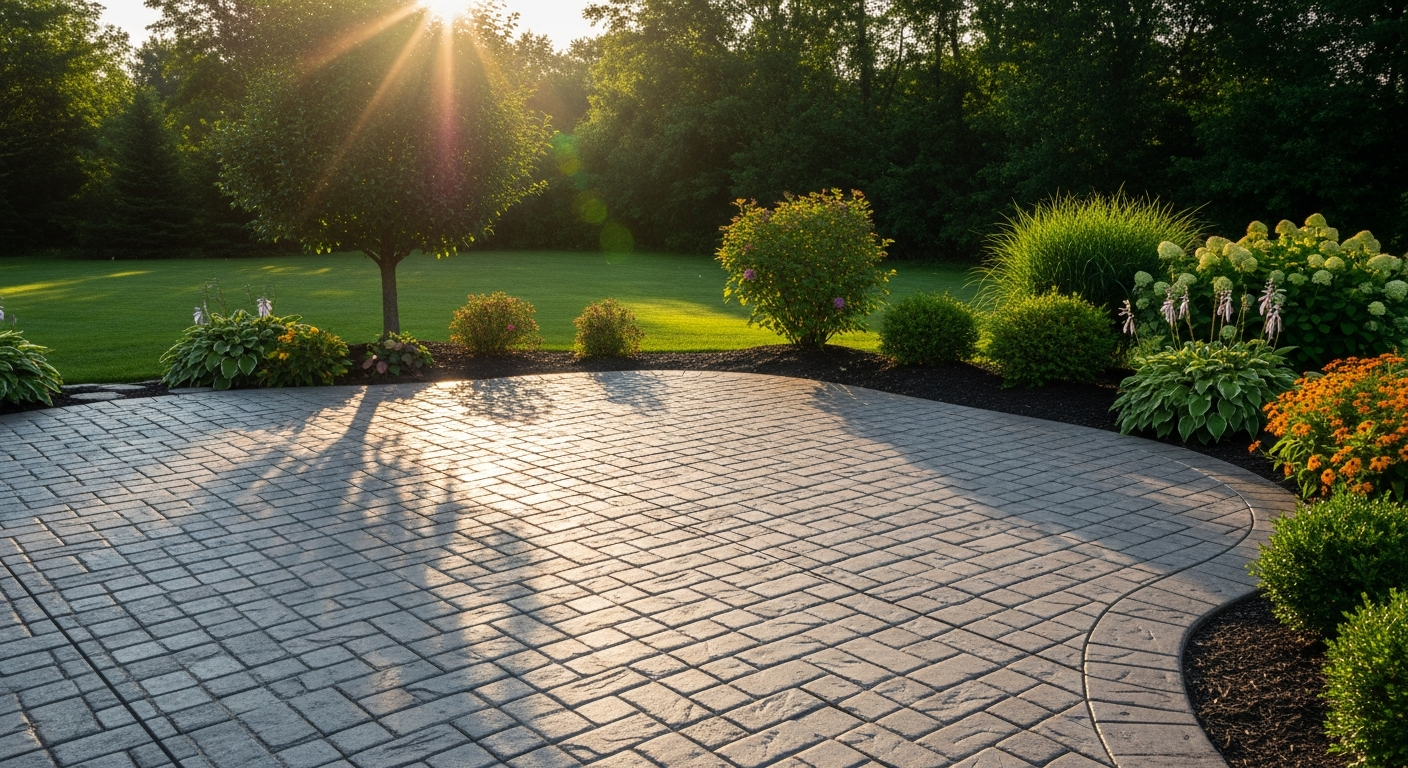
A paver patio is hundreds of individual units laid over a compacted gravel base and a thin bedding layer. The joints between pavers are filled with sand, often a polymeric sand that hardens, and an edge restraint holds the field together so it cannot spread.
That structural difference, one rigid slab against many small units that can move a little, explains most of what follows.
Freeze-Thaw: The Michigan Test
Southeast Michigan goes through many freeze and thaw cycles every winter. Water gets into the ground and into the surface, freezes, expands, thaws and does it again. On the clay soils common across Oakland County, the ground also holds water and heaves.
- Stamped concrete: a rigid slab cannot flex, so when the ground moves unevenly it cracks. Control joints are meant to keep those cracks in straight, planned lines, but random cracks still happen, especially over a poorly compacted base or where a downspout dumps water beside the slab. Scaling, where the top layer flakes off, is another freeze-thaw failure, and salt makes it worse.
- Pavers: the joints act like thousands of small expansion joints. When the ground shifts, the pavers move a little with it instead of cracking. The typical failure is a low spot or a heaved section rather than a crack, and it almost always traces back to the base.
For either material, the base does most of the work. A properly excavated, compacted gravel base that drains well is what keeps a patio flat through Michigan winters. Skimping on excavation depth or compaction is the most common reason patios fail here, whatever is on top.
Salt and Winter Care
- Stamped concrete is sensitive to de-icing salt, especially in its first winter. Many concrete suppliers advise against salting new concrete at all that first season. Sealer helps, but it wears and has to be reapplied.
- Concrete pavers are made from dense, high strength concrete and generally tolerate de-icing salt better. Salt can leave a white residue, and so can efflorescence, a natural mineral bloom that usually fades on its own.
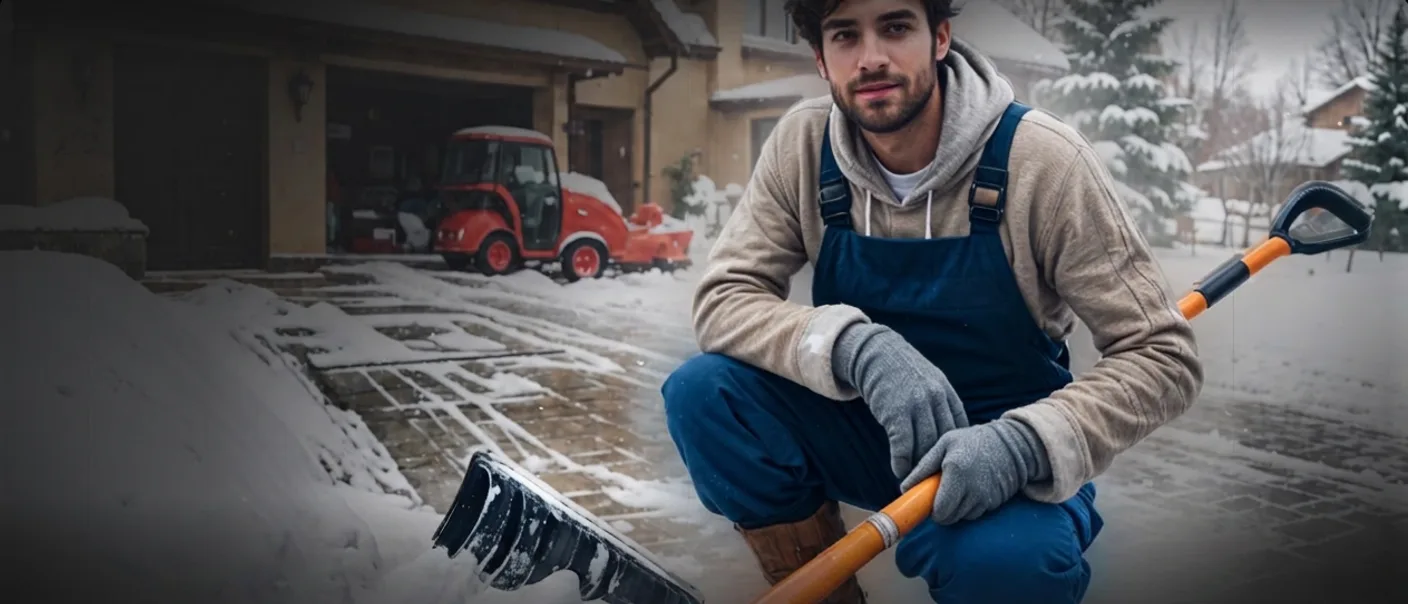
- Both can be shoveled and plowed. On pavers, a blade or shovel with a rubber or poly edge avoids chipping the edges.
- Sealed stamped concrete can be slick when wet or icy. Ask about a slip resistant additive in the sealer, especially on steps.
Repair: What Happens When Something Goes Wrong
This is where the two materials differ most.
- Stamped concrete: cracks can be filled and the surface resealed, but it is very hard to make a repair disappear. Color and texture rarely match the original exactly, and a badly cracked or sunken section usually means cutting it out, repouring and trying to blend the new piece in.
- Pavers: a sunken or heaved area can be lifted, the base corrected and the same pavers relaid. A stained or broken paver can be swapped out. Keep a few spares from the original install, because the same product can be hard to find years later.
- Access underneath: if a gas, water or sprinkler line under the patio ever needs work, pavers come up and go back down. Concrete gets sawn.
Maintenance Over Time
- Stamped concrete: plan on resealing every few years to protect the color and the surface, more often in full sun or heavy use. Faded color can be refreshed with a tinted sealer.
- Pavers: joint sand needs topping up now and then. Polymeric sand cuts down on weeds and ants, but it is not permanent. A cleaning and optional sealing every few years keeps the color fresh.
Neither is maintenance free. Pavers tend to need small, regular attention. Stamped concrete tends to need less for a while, then bigger fixes when it does.
Look and Design Flexibility
- Stamped concrete can imitate slate, flagstone, brick or wood plank in a wide range of colors, with a seamless surface and no joints. Large, simple shapes go in quickly.
- Pavers come in a huge range of shapes, sizes, textures and colors, from tumbled cobbles to large smooth slabs. Borders, inlays, curves and steps are straightforward. Permeable pavers, which let water drain down through the joints into the base, are an option where drainage is a concern.
- Both pair well with walkways, retaining walls and fire pits. Pavers are easier to match to block walls and caps.
What Drives the Cost
A blog post cannot price your patio, because the site matters so much. These are the things that move the price of either material:
- Size and shape: square footage matters, but so do curves, angles and multiple levels. Complex shapes mean more cutting and more labor.
- Excavation and base: how deep the dig goes and how much gravel goes back in. Heavy clay, poor drainage, or a surface that has to carry vehicles all call for more base.
- Access: if a skid steer can drive into the backyard, the job goes faster. If everything moves by wheelbarrow, labor goes up.
- Removal: tearing out an old patio, deck or slab and hauling it away is its own line item.
- Grading and drainage: a patio has to slope away from the house. If the yard slopes toward the house now, that gets fixed first, sometimes with a drain or a retaining wall.
- Material choice: premium pavers, natural stone borders, and intricate stamp patterns with several colors all cost more than the basic options.
- Details: steps, seat walls, borders, inlays, lighting and built-in features add up.
As a general rule, stamped concrete often costs less up front for a simple shape, while pavers tend to cost less to repair over the life of the patio. If you are undecided, get both priced on the same design so you are comparing like with like.
Which One Should You Choose?
- Choose pavers if you want a patio you can repair without it showing, you have clay soil or drainage worries, you want to salt freely in winter, or you want borders, curves and steps.
- Choose stamped concrete if you want a seamless look, the design is a large simple shape, and you are comfortable with resealing and the chance of visible cracks down the road.
- Either way, spend money on the base before you spend it on the surface.
If you are weighing both for your yard, start with patio design, read about our concrete work, or request a quote and ask for both options on the same layout.